By Eunwol · How we work & disclosure Bad breath sends people toward the vet and toward the pet aisle at once. This page sorts out which comes first, answers the questions owners type (sudden, fishy, puppy, an older or very sick dog), then reads the dental product records line by line.
Bad breath sends people toward the vet and toward the pet aisle at once. This page sorts out which comes first, answers the questions owners type (sudden, fishy, puppy, an older or very sick dog), then reads the dental product records line by line.
Disclosure. We did not buy, feed or test any product named here. Nothing on this page comes from using a product. It analyses public records: the Veterinary Oral Health Council (VOHC) Accepted Products table, the VOHC trial protocol, the National Animal Supplement Council (NASC) member roster, and the veterinary sources named in each section. This page has no affiliate links, and Tested Paws takes no payment from any company named below. Some other articles on the site link to Amazon as an Amazon Associate; see our Disclosure page. This is not veterinary advice and it does not diagnose anything.
The short answer
- A changed smell is a reason to look in the mouth, and sometimes past it. If it came on suddenly, is strong or one-sided, or arrives with drooling, a dropped appetite, bleeding gums, pawing at the mouth, or changes in drinking or weight, call your veterinarian before buying anything.
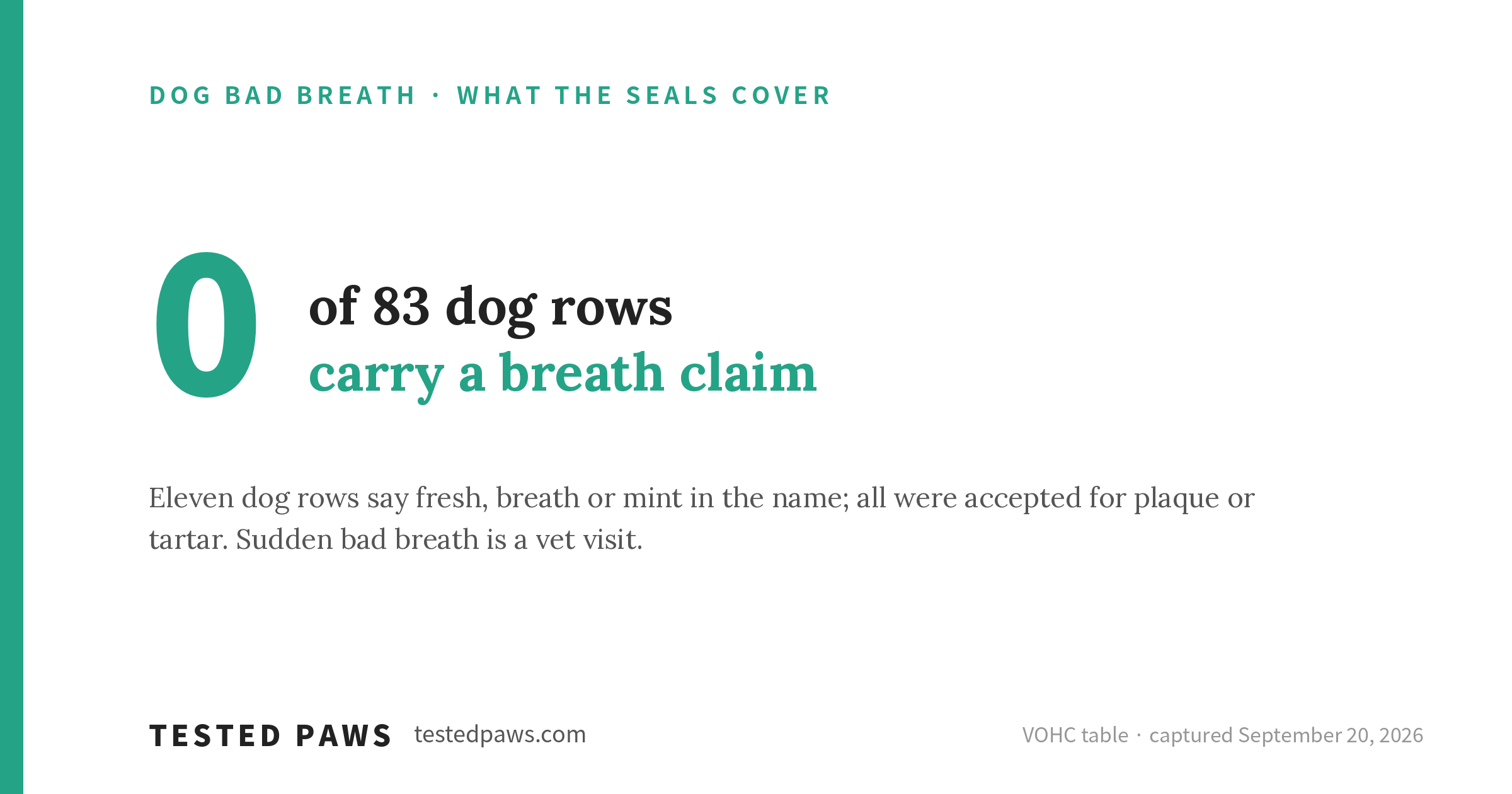
- No dental seal covers breath. Of the 83 dog rows on the VOHC register, zero carry a breath claim. The 11 dog rows with "fresh", "breath" or "mint" in the name were accepted for plaque, tartar or both, and seven of them for plaque alone.
- The two seals on the shelf answer different questions. VOHC Accepted is a tested plaque or tartar claim on one named product. The NASC Quality Seal is a quality-programme mark on a company. Only nine of NASC's 259 member companies hold any VOHC row.
When bad breath is a vet visit, not a shopping trip
The University of California, Davis School of Veterinary Medicine places the usual source in the mouth, in bacteria living in the film that coats the tongue, gums and other oral surfaces. It then names the exceptions: "Some systemic diseases (for example, liver disease, kidney disease and diabetes mellitus) can also cause bad breath." Its advice is that a dog with bad breath should be examined by a veterinarian. The Merck Veterinary Manual's owner pages add that "chronic kidney failure can cause inflammation and sores in the mouth", so a smell can show up in the mouth and still start elsewhere.
The AVMA lists bad breath first among reasons to have a pet's teeth checked sooner, ahead of loose or broken teeth, reduced appetite, bleeding from the mouth and swelling around it.
Go to the vet now, not after a two-week experiment, if any of these apply:
- The smell arrived suddenly or is unusually strong.
- It seems to come from one side of the mouth.
- Your dog is drooling, dropping food, pawing at the face, or eating less.
- Gums bleed, or you see swelling, a sore, or a loose or broken tooth.
- Drinking, eating or weight has changed.
None of the products below was tested on a dog with any of those problems. The reason is written into the trial rules, covered further down.
Why does a dog's breath suddenly smell bad?
Breath that comes and goes has a cause in your dog: what was eaten, what is happening at the gum line, or something only an examination finds. A product register cannot explain it, because it was built to record products, not patients.
That can be checked directly. We scanned all 1,901 cells of the two registers people cite most (606 VOHC cells: 101 rows by six fields; 1,295 NASC cells: 259 companies by five fields) for 14 timing words: random, sudden, occasional, intermittent, recur, flare, episod, vary, varies, fluctuat, temporar, again, onset, start. Every one returned zero. The only clock-like word on the VOHC list is "daily", which appears in seven product names as a usage instruction.
"Randomly" really hides six questions. A veterinarian will want all six answered, and you are the only person who can record them.
| What you are really asking | Field on VOHC (6 fields) or NASC (5 fields) that answers it | What to write down instead |
|---|---|---|
| When did it start? | None. The nearest is seal year, which dates a product | The first date you noticed it |
| How long does a bad stretch last? | None | The run of bad days before it eased |
| How often does it come back? | None | Every bad day, dated, so the gaps show |
| Why is it worse some days? | None | What was eaten that day, including treats and anything picked up outside |
| What changed just before? | None | New food, new chew, new routine |
| Does it return after a cleaning? | None | The date of the last dental cleaning |
One line a day for two weeks is enough. If a warning sign from the list above appears, skip the notes and call.
Does your dog's breath smell like fish?
None of the sources we read gives a fishy smell, or any particular smell, a meaning of its own. That is not a dodge; it reflects how veterinary dentistry decides things.
On the VOHC register, "fish" and "fishy" appear zero times across all 101 rows and six fields. So do tuna, seafood, shrimp, rotten, sour, sweet, metallic, ammonia, odor, odour, smell and halitosis. "Salmon" appears once, as a flavour in a cat treat name (Whiskas Dentabites, Chicken and Salmon flavors, tartar, 2017).
The official staging of gum disease, as printed in the American Veterinary Dental College nomenclature, is decided by measurement:
| Stage | AVDC wording (shortened) | Decided by | Smell mentioned |
|---|---|---|---|
| PD0 | "Clinically normal" | Clinical examination | No |
| PD1 | "Gingivitis only without attachment loss" | Attachment level, bone margin | No |
| PD2 | "Early periodontitis; less than 25% of attachment loss" | Probing or radiographs | No |
| PD3 | "Moderate periodontitis – 25-50% of attachment loss" | Probing or radiographs | No |
| PD4 | "Advanced periodontitis; more than 50% of attachment loss" | Probing or radiographs | No |
Where breath does appear, it appears early. The WSAVA Global Dental Guidelines say: "The first outward clinical sign of gingivitis is erythema of the gingiva, which is followed by edema and halitosis." The same guidelines list halitosis among occasional signs of a nasal problem. So a fishy smell is not a stage to wait out; it is a reason to have someone look, probe and, if needed, take radiographs.
Is it normal for a dog's breath to smell?
Some smell, yes. A dog's mouth is not meant to smell of nothing. Where ordinary ends is a clinical call, and no label can make it. What a label can tell you is what its seal covers, and the register is short on that.
Every one of the 101 VOHC rows carries one of four printed claim strings. We recounted them from the September 20, 2026 capture:
| Claim, exactly as printed | All rows | Dog rows | Cat rows | Company names on those rows | Seal years |
|---|---|---|---|---|---|
| Plaque, Tartar | 39 | 36 | 3 | 14 | 1998–2026 |
| Tartar | 31 | 28 | 3 | 23 | 2003–2026 |
| Plaque | 27 | 19 | 8 | 9 | 2008–2026 |
| Plaque & Tartar | 4 | 0 | 4 | 2 | 2001–2019 |
| Total | 101 | 83 | 18 | 40 strings | 1998–2026 |
Four wordings, two outcomes. Plaque is the soft film on the teeth; tartar is what that film hardens into. The ampersand form sits only on four cat rows from two companies and has not been used since 2019; read it as "both". Nothing in the table is about breath, gums or comfort.
Company names are counted as printed. The register uses several spellings for some firms (four for Nestle Purina, three for HealthyMouth), so the true number of businesses is lower than 40.
Does puppy breath smell? Puppy teeth vs adult teeth
None of the three veterinary sources behind our earlier puppy page attaches an odour to teeth coming in or falling out. What they do give is a schedule, and it explains why a puppy's mouth changes so much.
| Set | Formula, per WSAVA Global Dental Guidelines | Teeth | Teeth with no baby version |
|---|---|---|---|
| Puppy (deciduous) | 2x i 3/3 : c 1/1 : p 3/3 | 28 | — |
| Adult dog (permanent) | 2x I 3/3 : C 1/1 : P 4/4 : M 2/3 | 42 | 14 (10 molars, 4 first premolars) |
| Kitten (deciduous) | 2x 3/3 : c 1/1 : p 3/2 | 26 | — |
| Adult cat (permanent) | 2x I 3/3 : C 1/1 : P 3/2 : M 1/1 | 30 | 4 (all molars) |
A veterinary trade reference on eruption puts baby teeth erupting between three and six weeks and permanent teeth starting at about three months. A University of Minnesota teaching chapter puts the changeover as largely complete by four to six months, with canines lost at about six months. That leaves roughly three months when both sets share the mouth.
The register has almost nothing for that stretch. One row of 101 names a puppy: Canine Greenies Puppy Dental Chews, four sizes, plaque and tartar, 2019. Seven say "Adult", all diets (five dog, two cat). "Kitten", "teething" and "deciduous" return zero.
Fits if your puppy chews steadily rather than gulping, and you want the only row that names its life stage. Skip or check first if the puppy is mid-changeover with sore or loose teeth: the trials scored adult dentition, and a bleeding gum during tooth loss and a bleeding gum from disease look alike to an owner. A new, strong or one-sided smell, or a puppy off its food or pawing at its face, goes to the vet.
How to make a dog's breath stop stinking: six steps, in order
Most advice starts at step two and hands you a product. The order below starts with the cause, then follows what the register holds for each step. We placed all 83 dog rows into the step they belong to and added columns no other list keeps.
| Step | Dog rows | Buyable without a vet | Rows with a plaque claim | Rows with a tartar claim | Newest seal | Rows from the 9 VOHC+NASC companies |
|---|---|---|---|---|---|---|
| 1. Find out why it smells | 0 | — | — | — | — | — |
| 2. Brush or wipe | 4 | 4 | 3 | 2 | 2026 | 1 |
| 3. Change the food | 14 | 7 | 7 | 14 | 2026 | 5 |
| 4. Give something to chew | 38 | 38 | 24 | 38 | 2025 | 29 |
| 5. Treat the water or apply by hand | 26 | 26 | 20 | 9 | 2026 | 5 |
| 6. Professional scaling | 1 | 0 | 1 | 1 | 2011 | 0 |
| All dog rows | 83 | 75 | 55 | 64 | — | 40 |
Arithmetic: 4 + 14 + 38 + 26 + 1 = 83. "Buyable without a vet" counts Consumer and Veterinary-and-Consumer rows; 7 diets and the 1 professional row are Veterinary Only, so 83 − 8 = 75, or 90.4%. The chew step includes the single rawhide-section row.
Two things fall out of the table. First, the claim leans by format. Chews and diets all hold a tartar claim (38 of 38, 14 of 14), while the water step leans the other way: 20 of 26 hold a plaque claim and only 9 a tartar claim. Second, the step you cannot buy is the one the register barely touches. Its only row is a 2011 sealant applied after scaling, 15 years old as of 2026. The scaling itself is a procedure, and the register accepts products.
The shelf sizes (4, 14, 38, 26, 1) record which companies paid for trials, not which step matters most. Brushing opened in 2014, sixteen years after the first diet in 1998.
Step 1: find out why it smells
Look in the mouth in good light and date the smell. If it is new, strong or one-sided, a veterinarian comes before step two. Every later step assumes the cause is plaque or tartar, and only an examination confirms that.
Step 2: brush or wipe
Four rows: a soft-bristle flat-head toothbrush (plaque and tartar, 2014), a HealthyMouth paste-and-brush kit (plaque, 2015), HealthyMouth wipes (plaque, 2016) and VETRADENT wipes (tartar, 2026). The two wipe rows arrived ten years apart.
Fits if your dog lets you hold the lip up for short sessions; this is the step with the plainest link to the soft film the plaque claim measures. Skip or check first if your dog clamps shut or the mouth seems sore. Forcing it helps no one, and a painful mouth is a step-one problem.
Step 3: change the food
Fourteen dental diets: seven hold both claims, seven tartar alone, and half are sold only through clinics.
Fits if the dog eats a dry diet anyway and your vet agrees a switch suits it. Skip or check first if your dog has another medical diet, is a picky eater, or you were hoping for a quick fix; a food change is the most disruptive step here, and the register says nothing about palatability.
Step 4: give something to chew
The deepest shelf: 37 edible chews plus one rawhide-section row, all with a tartar claim, 24 with plaque as well, none Veterinary Only. The VOHC dog chew comparison lays out all 38 rows.
Fits if your dog chews a piece down rather than swallowing it, and you want a tartar claim on the exact name you buy. Skip or check first if your dog gulps, has broken teeth, or already has hard brown deposits; no chew was tested on existing tartar.
Step 5: treat the water or apply by hand
Twenty-six rows: 17 plaque alone, 3 both, 6 tartar alone, and all buyable without a vet. Despite the heading, the section also holds gels, sprays, pastes and powders, so read the product name for the format. The no-chew products page sorts these rows.
Fits if your dog drinks steadily from one bowl or will let you apply a gel, and plaque is the claim you want. Skip or check first if your dog drinks less from a treated bowl, or if you are buying it for the smell itself; see the next section.
Step 6: professional scaling
The only row is a Veterinary Only sealant from 2011. Fits if the vet finds tartar already on the teeth; that is a job for a cleaning, and the cost is covered in how much dog tartar removal costs. Skip nothing here: if a vet recommends it, home products are the follow-up, not the substitute. More on that line in the tartar and plaque removal guide.
If the smell survives all six steps, that is the answer, not a failure of effort. Go back to step one.
"Fresh Breath" on the label: what those rows were accepted for
We pulled every dog row whose name contains "fresh", "breath" or "mint" and set the name against the claim.
| Product name on the register (shortened) | Section | Claim | Company on the row | Year |
|---|---|---|---|---|
| TropiClean Fresh Breath Dental Water Additive | Water additive | Plaque | Cosmos Corporation | 2020 |
| TropiClean Fresh Breath Max Strength | Water additive | Plaque | Cosmos Corporation | 2020 |
| TropiClean Fresh Breath Gut Health | Water additive | Plaque | Cosmos Corporation | 2020 |
| TropiClean Fresh Breath Hip & Joint Support | Water additive | Plaque | Cosmos Corporation | 2020 |
| TropiClean Fresh Breath Skin & Coat | Water additive | Plaque | Cosmos Corporation | 2020 |
| Naturel Promise Fresh Dental Water Additive | Water additive | Plaque | Cosmos Corporation | 2020 |
| Naturel Promise Fresh Dental Water Additive Hip & Joint | Water additive | Plaque | Cosmos Corporation | 2020 |
| Canine Greenies, five sizes (also FreshMint) | Chew | Plaque, Tartar | Greenies-Mars PetCare | 2007 |
| Dentastix Fresh PEDIGREE UK | Chew | Plaque, Tartar | Mars Petcare | 2024 |
| Purina DentaLife ActivFresh Daily Oral Care, European size | Chew | Tartar | Nestle Purina PetCare | 2021 |
| Pedigree Dentastix Original Large, Beef & Fresh Variety Pack | Chew | Tartar | Mars Petcare | 2024 |
The cross-tab: 11 of 83 dog rows (13%) carry a freshness word. Seven of those 11 (64%) hold plaque alone, against 19 of 83 (23%) across all dog rows. So a "fresh" name makes a plaque-only claim nearly three times as likely, mostly because one company filed seven water additives in one year. All seven water-additive rows here come from Cosmos Corporation in 2020; no breath-named row has been accepted in the six years since.
Fits if you already use one of these and plaque control is the job you want done; the seal on a TropiClean Fresh Breath bottle is real, and it backs the plaque claim. Skip or check first if the smell is the reason you are buying. "Fresh Breath", "Gut Health", "Hip & Joint" and "Skin & Coat" are the company's words. The council only grants plaque and tartar claims, so none of those extras was part of what it reviewed.
Dying dog smell: what the dental research leaves out
If an older or very ill dog's breath has changed and it frightened you, call your veterinarian today. The dental research cannot answer this question, and its own rules show why.
The VOHC Trial Protocol Requirements screen animals before day one. Two rules let dogs in; seven turn them away:
| Gate, in the protocol's words | Type |
|---|---|
| "Good general health" | Inclusion |
| "All VOHC teeth must be present and intact on both sides of the mouth" | Inclusion |
| "Severe periodontal disease of any of the VOHC teeth" | Exclusion |
| "A complete (FI = 3) furcation defect in any multi-rooted tooth" | Exclusion |
| "Attachment loss of ≥50%" | Exclusion |
| "Mobility (0-3 index) ≥2" | Exclusion |
| "Severe gingival inflammation (spontaneous bleeding or immediate bleeding on touching the gingiva)" | Exclusion |
| "Non-gingival inflammation, ulceration or mucosal laceration" | Exclusion |
| "Tooth resorption at the gingival margin in cats" | Exclusion |
General health is "assessed by physical examination, CBC, chemistry panel, and urinalysis, or otherwise assured by the veterinarian of record." Dogs on antibiotics or anti-inflammatory drugs are out for at least seven days before and during the trial. Teeth are scaled to zero on day zero, and only the cheek-facing surfaces of nine tooth positions per side are scored in a dog.
So every sealed result comes from well, freshly cleaned, untreated dogs. On the register itself, kidney, renal, liver, senior, gum, gingivitis and periodontal each return zero rows; "Aging Care" on one Greenies row (plaque and tartar, 2019) is the only life-stage word for an older dog. That is a limit of the evidence, not a hint about your animal. The protocol's own test of whether a dog is well is an exam with bloodwork, and that is the one to book.
Two seals on dog breath products: VOHC vs NASC
Many breath products carry a second mark: the NASC Quality Seal. It is easy to read the two as versions of the same promise. They are not.
- VOHC Accepted: one named product, two trials to a published protocol, a plaque or tartar claim.
- NASC Quality Seal: a company in a trade association's quality programme (facility audits, labelling rules, adverse-event reporting). In the September 22, 2026 roster, 168 of 259 members carry the supplement seal and one carries the treats seal.
We matched company names across both files, merging spelling variants of the same firm but not merging brands up to parents. Nine NASC members hold VOHC rows:
| NASC member | Name(s) on the VOHC register | VOHC rows | NASC supplement seal |
|---|---|---|---|
| Nestle Purina Petcare Company | Nestle Purina PetCare (4 spellings) | 13 | Yes |
| Mars Petcare | Mars Petcare, Greenies-Mars PetCare | 12 | Yes |
| SwedenCare USA | SwedenCare | 6 | No |
| Virbac Corporation | Virbac | 4 | Yes |
| Royal Canin | Royal Canin | 3 | No |
| Dechra Veterinary Products | Dechra, Dechra Veterinary Products | 3 | Yes |
| Ceva Animal Health | CEVA | 2 | Yes |
| Wellness Pet, LLC | Wellness Pet | 2 | Yes |
| Pets Best Life | Pet's Best Life LLC | 1 | Yes |
| Total: 9 of 259 members | 46 of 101 rows | 7 of 9 |
The overlap is tiny by company (9 of 259, 3.5%) and large by rows (46 of 101). Our step table above shows where it sits for dogs: 40 of the 83 dog rows, including 29 of 38 chews (76%) but only 5 of 26 water additives (19%). The two biggest water-additive holders, Cosmos Corporation (TropiClean, 7 rows) and HealthyMouth (6 rows in this section, 15 on the whole register under three spellings), are not on the NASC roster.
So in the aisle breath shoppers reach first, the two marks line up least. A VOHC row tells you about the product in your hand; an NASC seal tells you about the company that made it. Neither certifies breath. Absence from either list is not a failure: VOHC publishes acceptances only, and a company that never submitted leaves the same blank as one that fell short.
For the full register and what the seal means, see the VOHC accepted products guide.
Our method
Every count on this page comes from two files, recounted with a script on October 27, 2026, unless another source is named in the sentence.
- VOHC Accepted Products web table, captured September 20, 2026: 101 rows, six fields (section, product name, claim, company, availability, seal year). One row, ProDen PlaqueOff Soft Chews, prints no year. VOHC's PDF editions do not split every row the same way, so a count taken from a PDF can differ by a row or two.
- NASC member roster, captured September 22, 2026: 259 companies, five fields (company, member type, species, supplement seal, treats seal).
- Word scans are case-insensitive substring searches over every cell. Company counts use names as printed unless a sentence says otherwise.
- Quoted veterinary sources: VOHC Trial Protocol Requirements; AVDC Nomenclature; WSAVA Global Dental Guidelines; a University of Minnesota veterinary teaching chapter on dentistry; a veterinary trade reference on tooth eruption; UC Davis School of Veterinary Medicine, Halitosis in Dogs; Merck Veterinary Manual, Disorders of the Mouth in Dogs (owner version); AVMA, Pet dental care. These were read for our earlier articles between September 27 and October 8, 2026, and are quoted as read then.
- No score of our own. The register prints a pass, not an effect size, so we never rank one sealed product above another.
- Update rule: when VOHC or NASC posts a new edition, we recount, change the numbers and move the date at the top. If nothing changed, the date stays.
Frequently asked questions
Is there a VOHC-accepted product for bad breath?
No. The council grants plaque and tartar claims only. None of the 101 rows was accepted for breath.
Is TropiClean Fresh Breath VOHC approved?
Five TropiClean Fresh Breath water additives are on the list, all from 2020, and all five carry a plaque claim. "Fresh Breath" is the product name.
When is sudden bad breath in a dog urgent?
Treat it as a vet visit if it came on suddenly or arrives with drooling, a dropped appetite, bleeding gums, pawing at the mouth, swelling, or changes in drinking or weight.
Does bad breath mean a dog is dying?
No record or article can settle that. UC Davis notes that liver disease, kidney disease and diabetes can cause bad breath, which is why an exam, not a product, is the answer.
Is bad breath an early or late sign of gum disease?
Early, per the WSAVA guidelines: it follows redness and swelling as the first outward sign of gingivitis.
Is the NASC seal the same as VOHC Accepted?
No. NASC marks a company's quality programme; VOHC marks a tested plaque or tartar claim on one product. Nine NASC members hold VOHC rows.
I use a sealed chew and the breath still smells. Did it fail?
Not necessarily. It was tested for plaque or tartar, never breath. Go back to step one.
The bottom line
Treat the smell as information about your dog, not as a product category. Date it, look in the mouth, and call the vet if anything on the warning list applies. Once a vet has confirmed ordinary plaque or tartar on an otherwise healthy dog, the register becomes useful: pick the step your dog tolerates, find the exact product name, and read the claim beside the seal. That claim, plaque, tartar or both, is the whole of what was tested.
About this page. Written by Eunwol, who compiles and checks public pet-product records for Tested Paws. Eunwol is not a veterinarian, and no veterinarian reviewed this page. We do not test products. Our job is to copy official records accurately, count them, and say plainly what they cover.
Sources. VOHC Accepted Products for Dogs and Cats (web table captured September 20, 2026). VOHC Trial Protocol Requirements. NASC member roster (captured September 22, 2026). American Veterinary Dental College, Nomenclature. WSAVA Global Dental Guidelines. University of Minnesota veterinary preventive medicine teaching chapter on dentistry. UC Davis School of Veterinary Medicine, Halitosis in Dogs. Merck Veterinary Manual, Disorders of the Mouth in Dogs (owner version). AVMA, Pet dental care. "VOHC Accepted" is a registered certification mark of the Veterinary Oral Health Council, and the NASC Quality Seal belongs to the National Animal Supplement Council; this page is not affiliated with or reviewed by either body. Brand names belong to their owners.
Related: VOHC-approved dog chews: all 38 compared · VOHC accepted products: the full list and what the seal means · Dog dental products that need no chewing · Removing dog tartar: what home products can and cannot do · How much dog tartar removal costs
Comments
Post a Comment