By Eunwol · How we work & disclosure Bad breath sends people toward the vet and toward the pet aisle at once. This page sorts out which comes first, answers the questions owners type (sudden, fishy, puppy, an older or very sick dog), then reads the dental product records line by line.
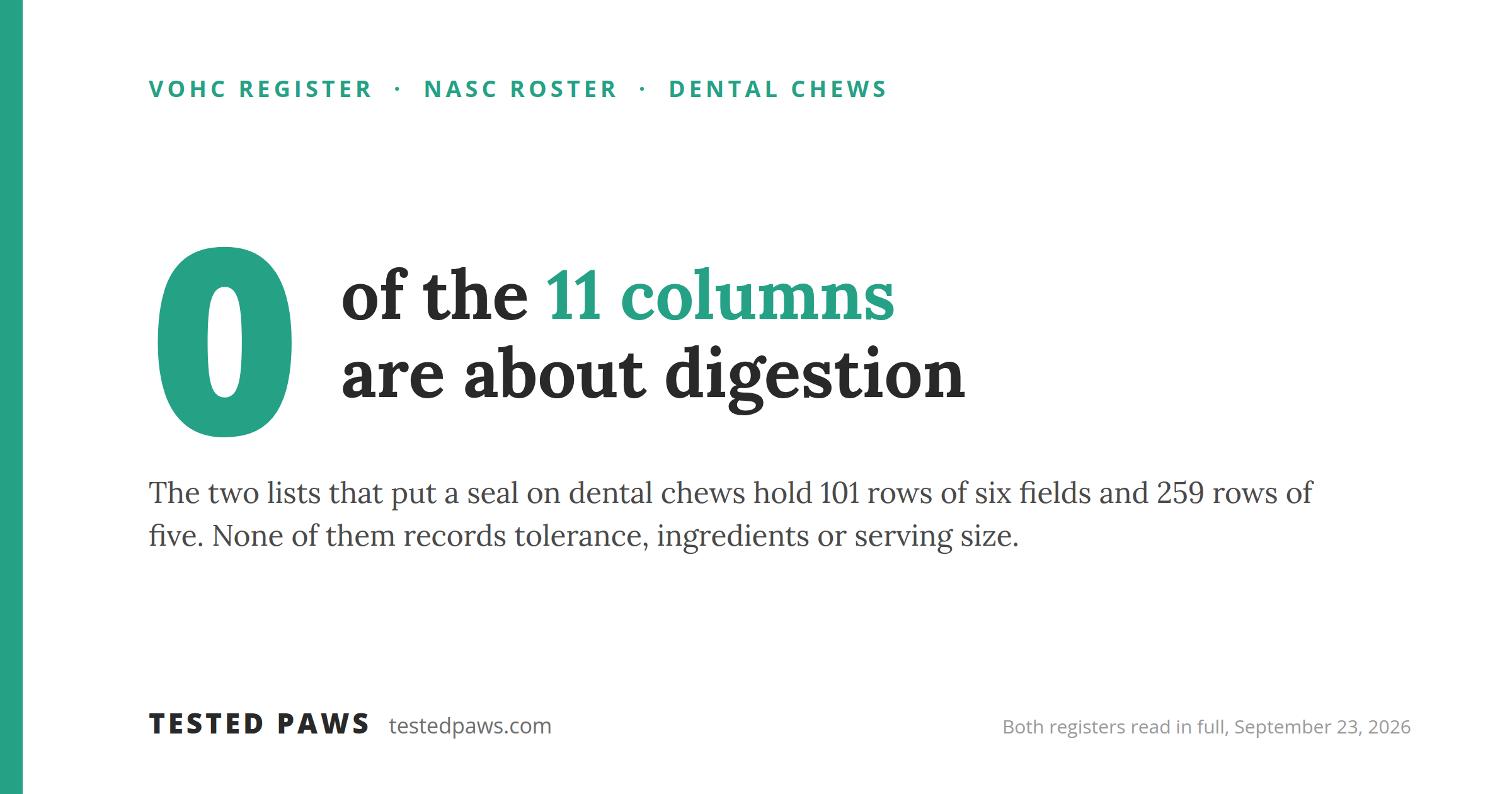
Last verified: October 6, 2026. Sources: the Veterinary Oral Health Council register of accepted products (101 rows, six columns) and the National Animal Supplement Council member roster (259 companies, five columns), both captured in September 2026 and read in full on September 23, 2026.
Your dog had a dental chew on Tuesday. By Wednesday something is wrong at the other end, and you are typing the question everyone types: can the chew have done it? You go looking for an answer on the bag, and the bag offers a seal. So the real question becomes whether the seal says anything about digestion, and that one we were able to settle by reading both registers behind the seals, every column, every cell.
Short answer first
- Yes, a dental chew is food, and food sometimes disagrees with a dog. Nothing in either register contradicts that, because neither register looked.
- Between them the VOHC register and the NASC roster hold eleven columns and about 1,900 filled cells (read September 23, 2026), and not one field is about how a dog digests the product. A scan for sixteen digestion and safety terms returned zero.
- So if your dog is unwell now, the register is not where the answer is. The package, the timing of what else changed, and your vet are, roughly in that order of speed.
Why would anyone expect the seal to cover this?
Because of what a seal looks like. A round mark on a food package reads like a clearance: somebody official checked this and it is fine. For human food that reading is close enough. For a dental chew the seal was granted for one narrow thing, a measured reduction in plaque or tartar over a 28-day trial, and the shopper's eye stretches it to cover everything else that could go wrong with a treat. The stretch is understandable. It is also where the question goes astray, because a plaque score and a stool chart are two different instruments and only one of them was ever in the room.
Think of it as a driving test. Passing proves you handled the car on the day; it says nothing about whether the car gives you motion sickness. The register is the examiner's sheet, and it has no column for the passenger.
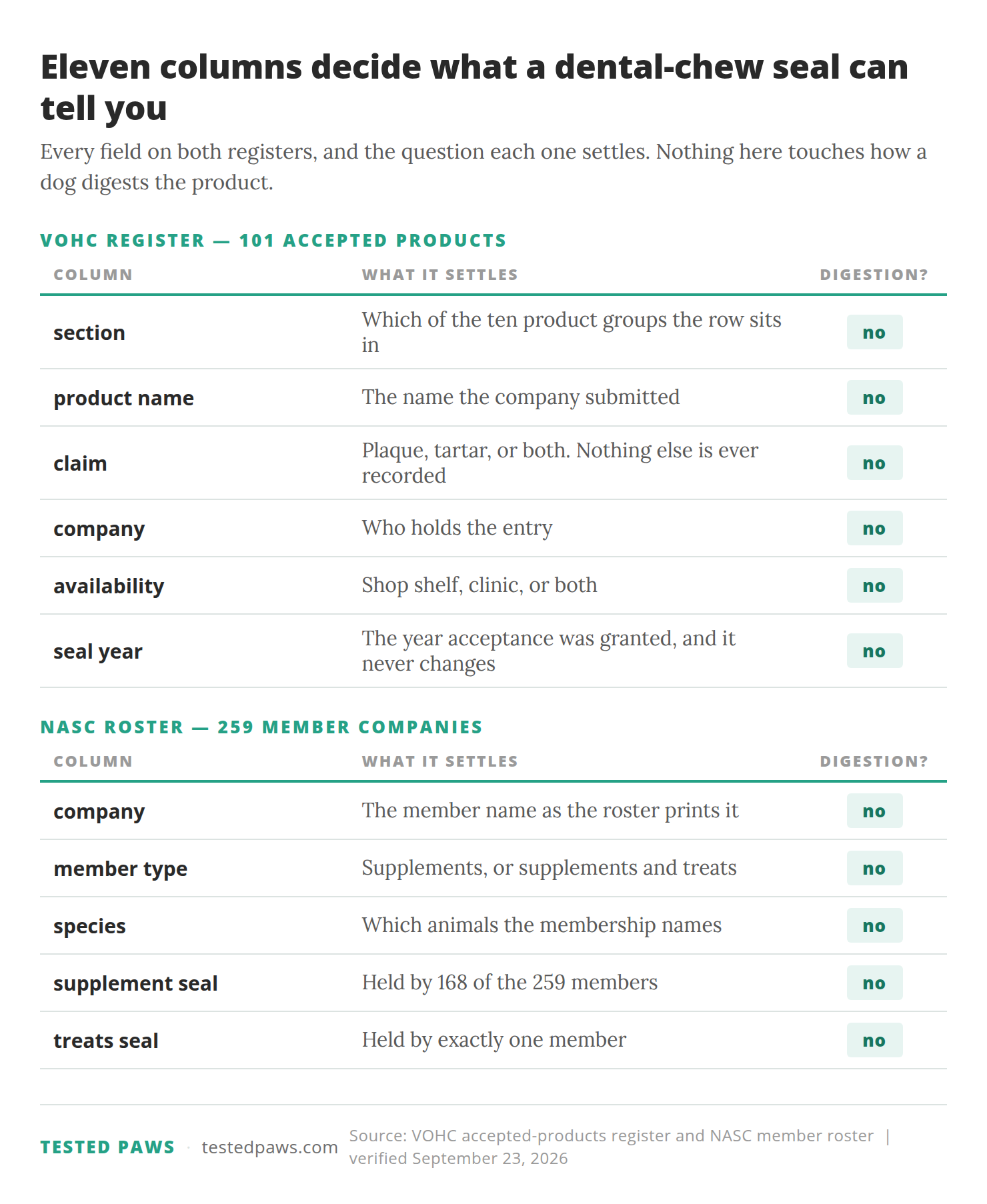
What did we actually find when we read all eleven columns?
Six questions a worried owner asks, put to each register in turn. Every “No” below is a count, not an impression.
| What you want to know | VOHC register — 101 rows, 6 columns | NASC roster — 259 companies, 5 columns |
|---|---|---|
| Was it tested for digestive tolerance? | No. Only two claims are ever recorded, and both describe deposits on a tooth | No. The seal follows an audit of the company, not a trial of a product |
| Are the ingredients recorded? | No. The word “ingredient” appears zero times in 606 cells | No. The five columns are company, member type, species, and two seal flags |
| Is there a daily amount or serving size? | No. “Dose”, “dosage” and “serving” — zero each | No. Same scan, same result |
| Is the dog's weight or size used to gate the entry? | No. “Size” turns up 14 times and every one of them is inside a product name | No. Species is recorded; body size is not |
| Is the maker checked on how it manufactures? | No. That is not what acceptance is | Partly. 168 of the 259 members carry the supplement Quality Seal. Exactly one carries the treats seal |
| Can a reaction be reported into it? | No such column. A row carries its seal year and nothing that changes afterwards | No such column. |
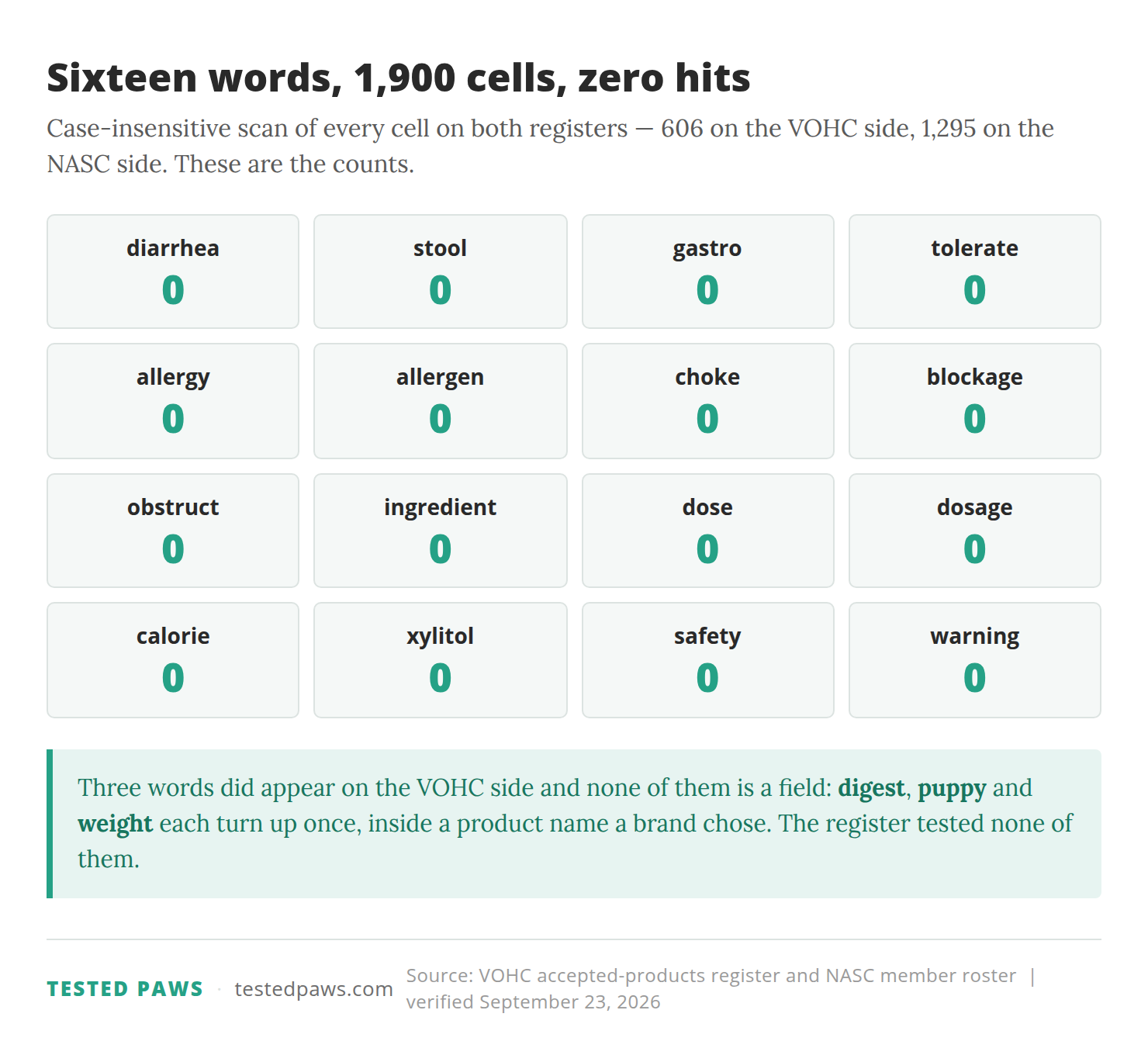
The scan behind the table covered all six VOHC columns and all five NASC columns for sixteen terms: diarrhea, stool, gastro, tolerate, allergy, allergen, choke, blockage, obstruct, ingredient, dose, dosage, calorie, xylitol, safety, warning. Zero hits across both registers.
Three near-misses did turn up on the VOHC side, and they are worth a sentence each because they are the ones most likely to mislead you: digest, puppy, weight. All three sit inside product names, Purina DentaLife Plus Digestive Support, Canine Greenies Puppy, Canine Greenies Weight Management. A brand chose those words for its packaging. The register did not test them, and the row beside each name carries the same six fields as every other row.
One line for this section: eleven columns, zero about digestion, and the three words that look like exceptions are brand names.
How much of the register is chews, and what does a chew row hold?
More than you might guess. Of the 101 accepted products, 42 are chews or edible treats: 37 dog chews, four cat treats and one rawhide, held between twenty companies. So if you are asking this question, you are asking it about the biggest single slice of the list.
Here is everything a row tells you about one of those 42: which section it sits in, the product name as the company wrote it, whether it was accepted for plaque or tartar or both, the company, whether it reaches a shop shelf or a clinic, and the year the seal was granted. That is the whole record. Six fields. The complete index of all 101 rows shows the same six repeating down the page, and the gaps are easier to see when they repeat.
If you have read our Kirkland and Greenies comparison, you have seen the same absence from the shopping side: price, calories and choking risk all came back empty on the same scan. The list was never built to answer those questions either.
Why would a 28-day trial not have caught it?
Because of what it measures. Acceptance rests on trials that run 28 days and score what accumulates on the teeth: plaque, or tartar, or both. The animals in those trials are a test group, and the endpoint is a deposit score. A product clears the protocol cleanly and still disagrees with an individual dog, and nothing about that outcome contradicts the seal, because the seal never spoke to it. What “VOHC Accepted” actually means goes through the protocol in full.
The claim wording carries the same limit. Across all 42 chew and treat rows there are only two things a product is ever accepted for, and both are descriptions of build-up on a tooth. Neither is a statement about tolerance.
Is the NASC seal the stricter one, then?
Stricter in a different direction. The NASC Quality Seal is a real audit, aimed at how a member company makes and labels its supplements, not at whether one chew agrees with one dog. And for a dental chew specifically, the NASC route is nearly empty. Of 259 member companies, 256 are listed for supplements only. Two list a treats membership. One carries the treats seal.
So if you were hoping the supplement seal on a chew bag meant somebody fed this chew to dogs and watched, it did not. The overlap between the two lists is set out in the piece on companies that appear on both, and the fuller count of who holds which seal is in the roster breakdown.
What should you check instead, and in what order?
Fastest first. The vet row is not optional if the dog is unwell; the others are what you do while you are getting there.
| Where to look | What it settles | What it cannot settle |
|---|---|---|
| The package itself | The ingredient panel and the feeding guide are printed there because feed labelling law requires them. Neither register copies that information | Whether your dog reacts to any of it |
| How much was given, and how fast | A chew introduced today alongside a new food, a new treat and a new water additive leaves four suspects, not one | Causation |
| The manufacturer's own care line | Batch and lot questions, and whether the recipe changed recently. The register keeps no version history | Anything clinical |
| A vet — required for this part | Whether the symptom needs treatment, and whether the chew is even the likely cause | — |
| A route with no chewing at all | Water additives and wipes make up the accepted dog products that need no chewing and no diet change | Whether they suit your dog either |
The row most owners get wrong is the second. Dental chews tend to arrive during a general shake-up, a new bag of food, a new season, a new routine, and a single change is the only kind anyone is able to read. If you changed three things on Tuesday, you have three suspects, and the chew is not automatically the guilty one because it is the newest.
So is it ever the chew?
Of course it is, sometimes. The point of this page is not that chews are blameless; it is that the seal has no opinion either way. A chew that disagrees with your dog and a chew that suits it perfectly carry the same six fields on the same register. If you want to know whether this chew suits this dog, the only instrument that measures it is the dog, introduced to one new thing at a time, with the ingredient panel in your hand.
What we could not check
We read two registers, not any dog, so we have nothing to say about how often chews cause upset, which ingredients are the usual culprits, or whether a particular brand is gentler than another; none of that is recorded anywhere we looked, and we are not going to invent it. Both lists are snapshots from September 2026 and both change. And the limit above all the others: if something is wrong with your dog right now, the symptom, the cause and any change of diet belong with a veterinarian, not with a count of cells.
What to do today
Read the ingredient panel and the feeding guide on the bag, write down everything else that changed this week, and ring the vet if the dog is unwell rather than waiting to see. Leave the seal out of the reasoning entirely; it was never a statement about digestion, and after counting every cell in both registers we are able to say exactly how little they hold on the subject: eleven columns, zero of them about this.
Frequently asked questions
Can dental chews upset a dog's stomach?
They are food, so yes, for some dogs. Neither the VOHC register nor the NASC roster records anything about tolerance, so the seal does not tell you which dogs.
Does VOHC test dental chews for safety?
No. Acceptance follows 28-day trials that score plaque or tartar on the teeth. A scan of all 606 VOHC cells for “safety” and “warning” returned zero.
Are VOHC accepted chews easier to digest?
The register does not say. The word “digest” appears once, inside a product name (Purina DentaLife Plus Digestive Support), which is a brand's wording, not a tested claim.
Does the NASC seal mean a treat was tested on dogs?
No. It follows an audit of the company's manufacturing and labelling, and only one of 259 members holds the treats seal at all.
How many VOHC accepted products are chews?
Forty-two of 101: 37 dog chews, four cat treats and one rawhide, from twenty companies.
How we checked
VOHC register: 101 accepted products, columns section, product name, claim, company, availability, seal year. NASC roster: 259 member companies, columns company, member type, species, supplement seal, treats seal. Both read in full on September 23, 2026 and scanned case-insensitively for the sixteen terms named above; chew and treat rows are the three chew sections combined (37 dog edible chews and treats, four cat edible chews and treats, one dog rawhide chew). Updated 2026-10-06.
Sources: Veterinary Oral Health Council, register of accepted products for dogs and cats, vohc.org. National Animal Supplement Council, member roster, nasc.cc. Both verified September 2026.
Tested Paws has no affiliate relationship with any company named here and earns nothing from any purchase. Nothing on this page is veterinary advice.
Checked again on 8 October 2026
We re-read the VOHC Accepted Products page on 8 October 2026. Still 101 rows: 83 dog, 18 cat. The chew share is still 42: 37 dog edible chews, four cat treats, one rawhide. Each row still prints the same five fields: product name, claim, company, availability, seal year. Nothing on stool, tolerance or ingredients. The dog PDF VOHC links to is now filed as 8-25-26 and the cat PDF as 8-5-26; both sit before the 23 September read the counts above rest on. Result: same.
What the trial does check, and what to watch at home
The register prints nothing on safety. The protocol behind it is not silent. VOHC's protocol page lists two safety measures per trial. One is a gingivitis score. The other is "observation for non-gingival inflammation or oral ulceration or laceration, at the beginning and end of the trial." Both look inside the mouth. Stool is not recorded. Calories are not recorded. The same page counts gut obstruction as a safety issue, but the only route for that news is the sponsor, who affirms each year that no new complaints came in. An affidavit, not a digestion trial.
The home checks fall to you, and Cornell's Riney Canine Health Center sets a plain limit: "If loose stool lasts more than two days, call the vet." The same page says to call sooner if the dog stops eating, turns lethargic, vomits as well, or passes black or tarry stool. It also advises holding back rich food and extra treats until the stool settles, and notes that a food switched too fast can upset a dog by itself. A new chew is a new food.
| Watch for | Who says so |
|---|---|
| Loose stool past two days | Cornell |
| Black or tarry stool, vomiting, lethargy, not eating | Cornell |
| Dropping food, drooling, bleeding from the mouth | AVMA |
The AVMA covers the mouth side. Its reasons to have teeth checked sooner include abnormal chewing, drooling, dropping food and bleeding from the mouth. None of this is in any seal. Ask your vet. Take the bag.
Related on Tested Paws: All 83 dog products on the VOHC list — the full dog register, sorted by format; How many chews a day? — why the bag, not the seal, sets the number; 31 dog products that need no chewing — water additives, wipes and the sealant.
Sources: VOHC Accepted Products (read 8 Oct 2026; dog PDF dated 25 Aug 2026); VOHC Protocols and Submissions (read 8 Oct 2026); Cornell University College of Veterinary Medicine, Diarrhea (updated March 2024; read 8 Oct 2026); AVMA, Pet dental care (read 8 Oct 2026).
Comments
Post a Comment